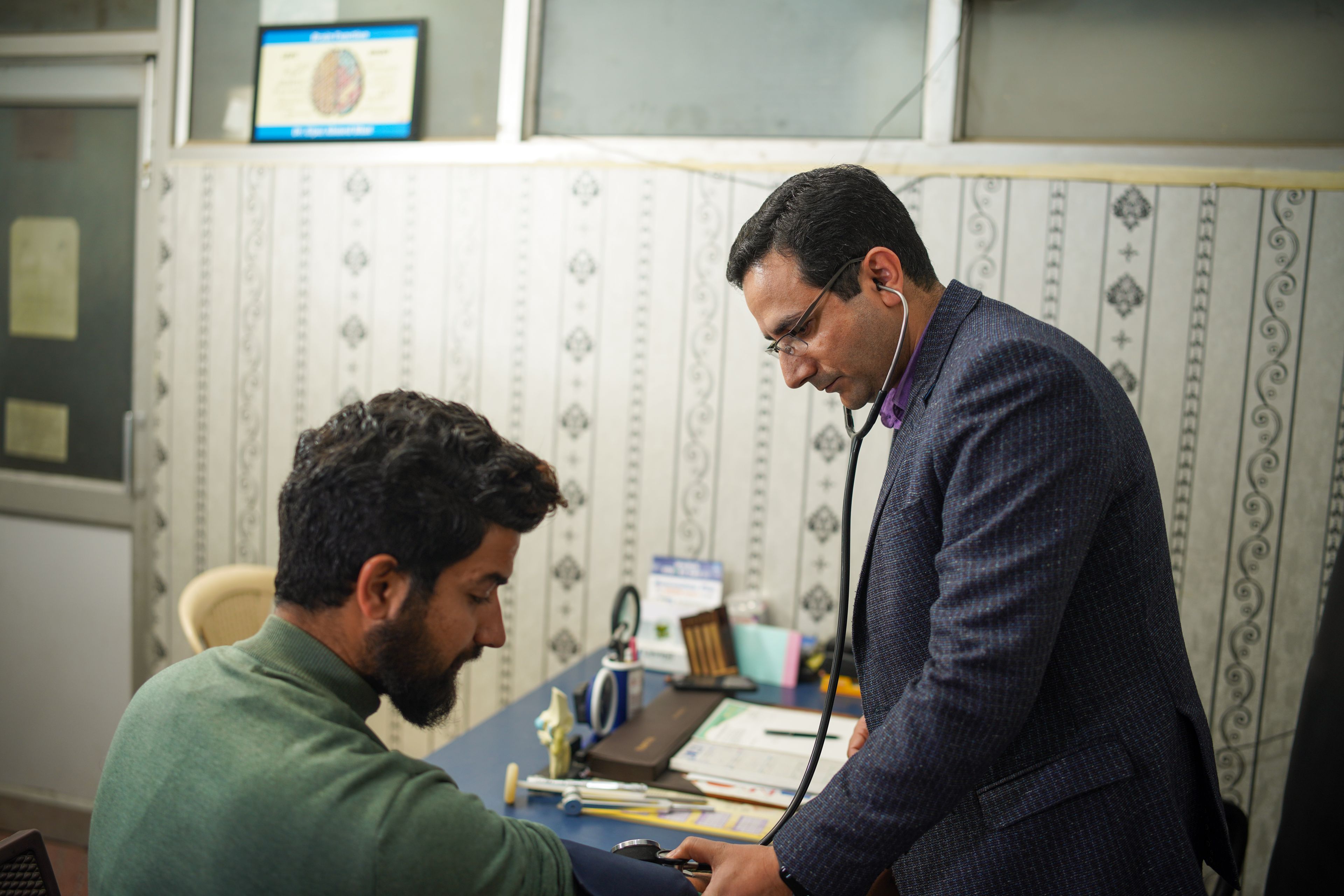
Svasthya brings together intelligent health sensors, cloud technology, and AI-assisted analysis to help healthcare professionals monitor patients remotely, identify potential concerns, and make informed decisions — anytime, anywhere.
Flagged for reviewLive readingsIllustrative · four settings, one doctor’s view
Care beyond the hospital
The hospital stay ends. The need for care doesn’t.
After discharge, a patient’s condition can change, with no clinician there to see it.
A quiet night, until 02:10
Blood oxygen (SpO₂), 20:00 to 08:00
NightSpO₂Doctor’s thresholdIllustrative data
With Svasthya, nothing goes unseen.
The patient, at home
Sensor readings
Svasthya cloud platform
The doctor, kept informed
Svasthya
Review suggested
SpO₂ 91%, below your threshold. This patient has been prioritised for your attention.
02:10
The illustration shows four parts of the service:
The patient, at home
Sensor readings
Svasthya cloud platform
The doctor, kept informed
The Svasthya sensor hub.
What we measure
Ten vitals from one wearable.
Single-lead ECGWaveform · mV
Heart ratebpm
Blood oxygenSpO₂ · %
Skin temperature°F
Cuffless blood pressuremmHg
ActivitySteps · movement
SleepDuration · deep sleep
Nocturnal HRVHeart-rate variability
LocationGPS
Patient contextLogged in the app
How it works
From a sensor reading to an informed doctor.
Four steps, set up for each use case and run by our team.
01
Measure
A wearable sensor hub captures around ten parameters.
02
Combine
Algorithms align readings in time and combine them into indicators.
03
Analyse
AI looks for patterns and changes over hours and days.
04
Inform
Doctors see who needs attention, with alerts by app, SMS or email.
Major use cases
Wherever the patient is.
Step-down careDoctors stay informed when they’re elsewhere.
OPDPoints patients to the right specialist sooner.
Home carePatients at home, monitored by their doctor.
Public screeningMany people screened, reviewed remotely.
AmbulanceVitals reach the doctor from the ambulance.
Applications
Svasthya in practice
Step-down care
Shankara ICU
ICU step-down patients on continuous monitoring. The intensivist stays informed while away.
Oncology
Step-down
Programme
Sarvarakshana
Health screening and follow-up, with readings reviewed by doctors remotely.
Screening
Study
Activity tracker
Daily activity and movement, tracked for rehabilitation and elder care.
Geriatrics
Study
Sleep study
Overnight sleep and nocturnal heart-rate variability, recorded at home.
Pulmonology
Study
Yoga HRV
Heart-rate variability measured before, during and after yoga.
Research
Emergency
Trauma care
Vitals followed from arrival through the emergency department.
Emergency
NICU
Neonatal ICU
Continuous monitoring of newborns, with alerts to the care team.
Pediatrics
AI research
Predictocomp
Predictive analytics on continuous vitals, to flag who may need attention.
AI
Research
AI and technology
Healthcare intelligence, powered by connected technology.
AI-assisted. Clinician-led.
Algorithms prioritise. Doctors decide.
Svasthya architecture: sensors and monitoring devices send information to a cloud-hosted platform, where algorithms analyse it and AI-assisted triaging prioritises it. Healthcare professionals receive updates and make clinical decisions.
Sensors and monitoring devices
Capture vitals in real time, wherever the patient is.
Patient information
Cloud-hosted platform
Secure, and available wherever the care team works.
Algorithms and intelligent analysis
Spot patterns and deviations from each patient’s health index.
AI-assisted insights and triaging
Early warning scores prioritise who needs attention.
Prioritised updates
Healthcare professionals
Review updates and decide on care.
Clinical judgement
In practice
What clinicians have said.
From hospitals and medical camps in Karnataka where Svasthya has been used.
Tantragyaan’s Svasthya platform measures multiple vital body parameters continuously real-time which can be monitored remotely by doctors. This helps in providing healthcare access to people in remote areas. Svasthya has facilitated bio-signal monitoring of patients at our hospital
1Dr Chetan KalkuraMedical Director and Pediatrician, RNS Hospital, Murudeshwara
2Dr Karthik S RishiRadio Oncologist, Shankara Cancer Care, Bengaluru
Tantragyaan has facilitated bio-signal monitoring of patients using their Svasthya platform at our medical camps. Svasthya is an effective platform for remote, real-time health discovery
3Dr Sandeep PaiConsultant Physician and Emergency Medicine Specialist, Jeevan Jyothi Hospital, Brahmavara
Get in touch
Better patient visibility. More informed healthcare.
See how Svasthya can support your healthcare organisation.